
Learning how to invest in nasdaq 100 from india enables domestic investors to participate in the world’s most innovative technology conglomerates while diversifying across currencies. The Nasdaq 100 comprises the 100 largest non-financial companies listed on the Nasdaq stock market, including giants like Microsoft, Apple, Nvidia, Alphabet, and Amazon. Specifically, investing in US markets provides a natural hedge against long-term Indian Rupee depreciation.
Listen, boss, keeping 100% of your net worth strictly in domestic Indian assets exposes your wealth to geographical concentration risk. When you allocate a strategic portion of your portfolio to global tech leaders with undeniable economic moats, you compound capital in strong US Dollars. Over a multi-year horizon, combining Indian domestic compounding with US tech innovation delivers extraordinary portfolio resilience.
In this practical masterclass, our research desk explains how to invest in Motilal Oswal Nasdaq 100 ETF, breaks down RBI LRS limits, and analyzes tax rules. Before initiating international trades, reviewing basic stock market terms ensures you understand global order execution. In addition, mastering currency risk parameters protects your hard-earned capital from unexpected volatility.
What is Motilal Oswal Nasdaq 100 ETF (MON100) and How Does It Work?
The simplest route for Indian retail investors to gain Nasdaq exposure is through the Motilal Oswal Nasdaq 100 ETF, trading on NSE under ticker MON100. This domestic ETF invests directly in the underlying constituent shares of the Nasdaq 100 index in exact market cap proportions. Consequently, you can buy or sell units in Indian Rupees using your regular Zerodha, Upstox, or Groww demat account without opening foreign bank accounts.
Because MON100 trades during Indian market hours (9:15 AM to 3:30 PM IST), its market price occasionally trades at a premium or discount to intraday Indicative NAV. Therefore, smart investors always check the live NAV and execute limit orders rather than market orders. In addition, you can project multi-year compounding targets using our interactive sip calculator.
A classic Kannada proverb teaches us: “ದೂರದ ಬೆಟ್ಟ ಕಣ್ಣಿಗೆ ನುಣ್ಣಗೆ” (Doorada betta kannige nunnage — distant mountains appear smooth to the eye). Similarly, while investing in foreign markets sounds prestigious, you must thoroughly evaluate underlying currency conversion costs and tracking error. In fact, reviewing our guides on how to invest in china stocks from india and how to invest in japan stocks from india provides broad global perspective.

Illustration: 3 Practical Routes for Indian Investors to Access the US Nasdaq 100 Index
3 Practical Routes to Invest in US Tech Stocks from India
Indian residents can access US tech leaders through three distinct operational channels, each tailored to different capital sizes and trading styles. Comparing these investment avenues helps you balance transaction friction, currency spreads, and regulatory reporting requirements.
| Investment Route | Trading Mechanism | Key Advantages & Costs |
|---|---|---|
| Indian Domestic ETFs (MON100) | Trade on NSE/BSE in INR via Demat | Zero remittance paperwork; subject to RBI overseas limits |
| Fund of Funds (FoF Mutual Funds) | Direct SIP on AMC portals or Coin | No Demat required; NAV-based transactions; extra FoF fee |
| Direct US Brokerage (INDmoney / Vested) | Direct USD trading via RBI LRS Wire | Fractional shares; individual stock picks; 20% TCS above ₹7L |
First, investing via Indian ETFs avoids complex foreign exchange wiring fees entirely. Second, you can calculate transaction costs before placing orders using our zerodha brokerage calculator. In addition, you can project multi-year returns using our guide on how to calculate cagr in stocks.
In addition, investors who increase their monthly allocation annually can review compounding dynamics in our guide on step up sip vs regular sip. Similarly, you can compare fee schedules across competing discount brokers using our upstox brokerage calculator.
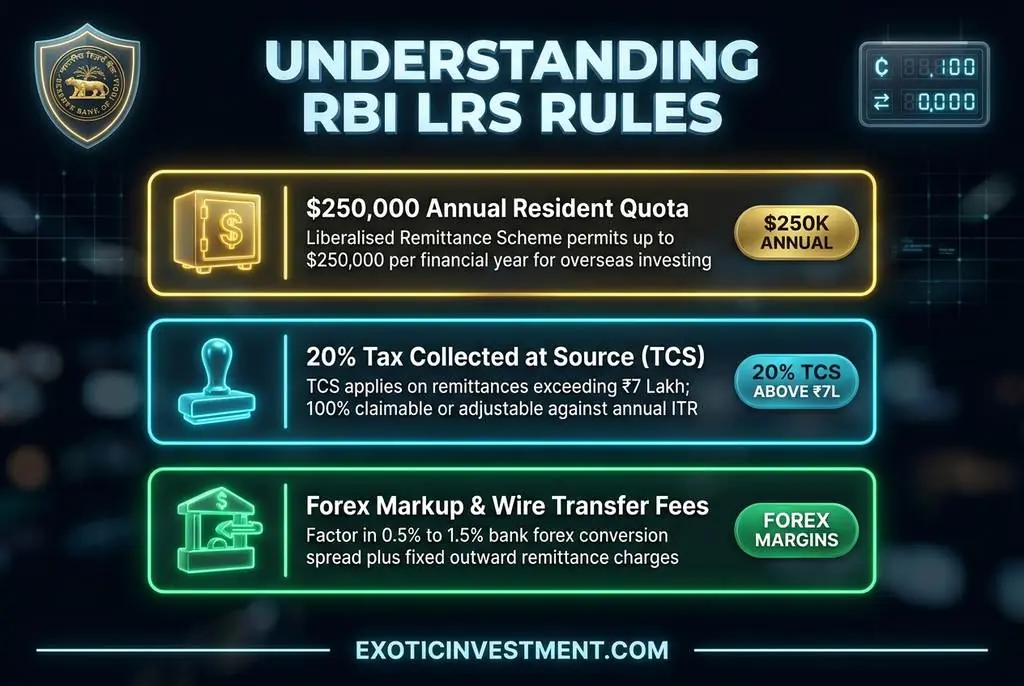
Illustration: RBI Liberalised Remittance Scheme (LRS) Rules: Quotas, TCS Thresholds, and Forex Spreads
Understanding RBI’s Liberalised Remittance Scheme (LRS) & Overseas Limits
Under the Liberalised Remittance Scheme (LRS), the Reserve Bank of India permits resident individuals to remit up to $250,000 per financial year for permissible capital account transactions. If you choose the direct US brokerage route via INDmoney, Vested, or interactive brokers, your funds travel through this legal LRS channel. However, you must track statutory Tax Collected at Source (TCS) rules carefully.
Specifically, outward remittances exceeding ₹7 Lakh in a single financial year attract a 20% TCS deduction by your remitting bank. While this TCS is not an additional tax and can be fully claimed or adjusted against your annual ITR, it temporarily locks up trading liquidity. Therefore, smart investors remit funds strategically before hitting major thresholds.
In addition, investors evaluating US growth stocks must factor in underlying valuation multiples before committing capital. You can estimate valuation metrics using our dedicated pe ratio calculator. In fact, studying corporate cashflow trends ensures you select profitable market leaders, as explained in our guide to how to read a balance sheet.
🚀 Master Global Portfolio Allocation & Compound Wealth
Build an all-weather investment portfolio combining Indian market leaders with global tech compounders. Learn directly from Dr. Ashok Kumar N Rao.
- Master foundational stock market principles with our book Kaliyiri Share Market Book and our English handbook Basics of Indian Stock Market Book.
- Accelerate your research with institutional screeners through the MultiBagger Plus Courses & Pro Tools Annual Subscription.
- Master chart setups by enrolling in our structured Technical Analysis Course in Kannada or options mechanics in our Options Buying Course in Kannada.
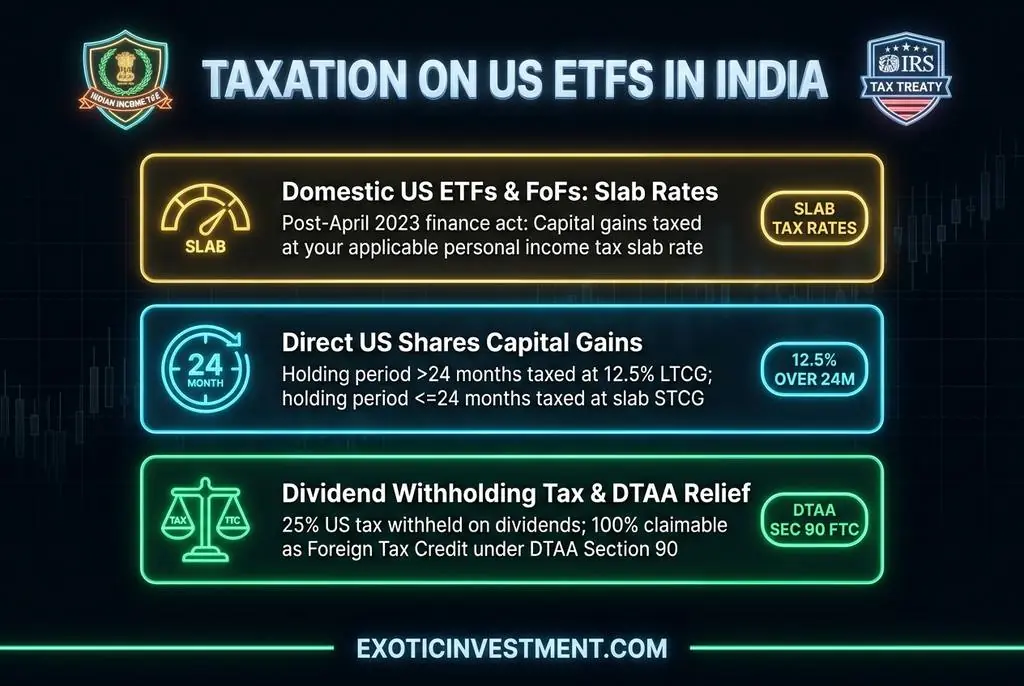
Illustration: Detailed Indian Taxation Roadmap for Overseas ETFs and Direct US Equities
Taxation on US ETFs and Direct Stocks for Indian Residents
Taxation rules on international funds changed significantly following the Finance Act 2023. Domestic mutual funds and ETFs investing overseas (like MON100) are classified as specified mutual funds where equity exposure in domestic shares is under 35%. Consequently, all capital gains are taxed at your applicable personal income tax slab rate, regardless of how long you hold the investment.
In contrast, if you hold direct US equities through an international broker, distinct capital gains rules apply. Specifically, shares held for 24 months or less trigger Short-Term Capital Gains taxed at slab rates, while holdings exceeding 24 months qualify for 12.5% Long-Term Capital Gains tax. Review complete income tax provisions in our guide to stock market profit taxation in india.
In addition, US dividends face a flat 25% withholding tax deducted at source in the United States. However, under the Double Taxation Avoidance Agreement (DTAA) between India and the US, Indian residents can claim Foreign Tax Credit (FTC) by filing Form 67. Discover top cash cows in our guide to dividend yield stocks in india.
Finally, disciplined capital allocation requires strict risk management, as outlined in our guide on risk to reward ratio and position sizing. In addition, you can estimate optimal trade sizing allocations using our position size calculator. Therefore, disciplined position limits protect your global portfolio through market cycles.
💡 Frequently Asked Questions
1. Can I buy Nasdaq 100 ETF on Zerodha Kite?
Yes, you can buy Motilal Oswal Nasdaq 100 ETF on Zerodha Kite under the ticker MON100 using Indian Rupees. It trades during regular NSE trading hours without requiring currency conversion. Learn more about trade fee breakdowns with our stock brokerage calculator.
2. Why do Indian AMCs halt fresh investments in US funds?
The Reserve Bank of India has an aggregate industry-wide limit of $7 Billion for mutual fund overseas investments. When industry limits are breached, SEBI directs AMCs to temporarily suspend lump-sum inflows until limits are revised. Learn how to manage cashflow and position allocation using our free position size calculator.
3. What is the minimum amount required to invest in US tech stocks?
If you invest through domestic ETFs like MON100, you can start with the price of a single unit, typically around ₹150 to ₹180. If investing directly via US brokers, fractional share investing allows you to start with as little as $1. Review systematic equity rules in our master guide on what is stock sip.
4. How does Rupee depreciation affect Nasdaq 100 returns?
When the Indian Rupee depreciates against the US Dollar, your dollar-denominated assets gain additional value when converted back to INR. Historically, the USD has appreciated at roughly 3% to 4% annually against the Rupee, boosting net rupee returns. Discover how direct funds outperform regular options in our direct vs regular mutual funds guide.
5. How do I avoid double taxation on US dividends?
The US broker deducts a 25% withholding tax on dividend distributions under the US-India tax treaty. You can claim this deduction as Foreign Tax Credit against your Indian tax liability by filing Form 67 before filing your annual ITR. Learn complete tax filing provisions in our guide to stock market profit taxation in india.