Discovering what is bharat 22 etf and understanding its sovereign constituent framework gives Indian investors access to high-yielding public sector powerhouses and select private champions. Launched by the Government of India under its central divestment mandate, the Bharat 22 Index is managed by ICICI Prudential Mutual Fund. Specifically, this exchange traded fund bundles 22 industry-leading companies spanning six key economic sectors.
Listen, boss, chasing unproven small-cap momentum stocks without studying fundamentals often leads to severe portfolio drawdowns. When you invest in cash-generating sovereign enterprises that own critical national infrastructure, you build a dependable foundation of capital growth and dividends. Over the long run, reinvesting dividends from monopolistic utilities and financial institutions compounds into serious wealth.
In this guide, our research desk evaluates the sector allocation, historical returns, dividend yield, and expense ratio of Bharat 22 ETF. Before purchasing units through your broker, reviewing basic stock market terms ensures you understand exchange order types. In addition, knowing how exchange traded products function prevents execution mistakes.
What is Bharat 22 ETF and How is It Structured?
The Bharat 22 ETF tracks the performance of the S&P BSE Bharat 22 Index, which was created to facilitate the government’s disinvestment program. Unlike traditional equity mutual funds that charge active management fees, Bharat 22 is passively managed with an ultra-low expense ratio of roughly 0.05%. Consequently, virtually all investment gains stay invested in your portfolio, avoiding the drag described in our guide to direct vs regular mutual funds.
To prevent any single stock or industry from dominating performance, the index enforces strict statutory caps. Specifically, individual company weight is capped at 15%, while any single sector is capped at 20% during periodic rebalancing. In addition, you can project your multi-year compounding wealth using our interactive sip calculator.
A classic Kannada proverb reminds us: “ಆಳವಾಗಿ ಬೇರೂರಿದ ಮರವು ಬಿರುಗಾಳಿಗೆ ಹೆದರುವುದಿಲ್ಲ” (Aalavagi beroorida maravoo birugaalige hedaruvudilla — a deeply rooted tree never fears the storm). Similarly, companies in the Bharat 22 ETF maintain unmatched sovereign balance sheets and critical national economic moats. Therefore, holding these enterprises provides resilience during volatile market corrections.
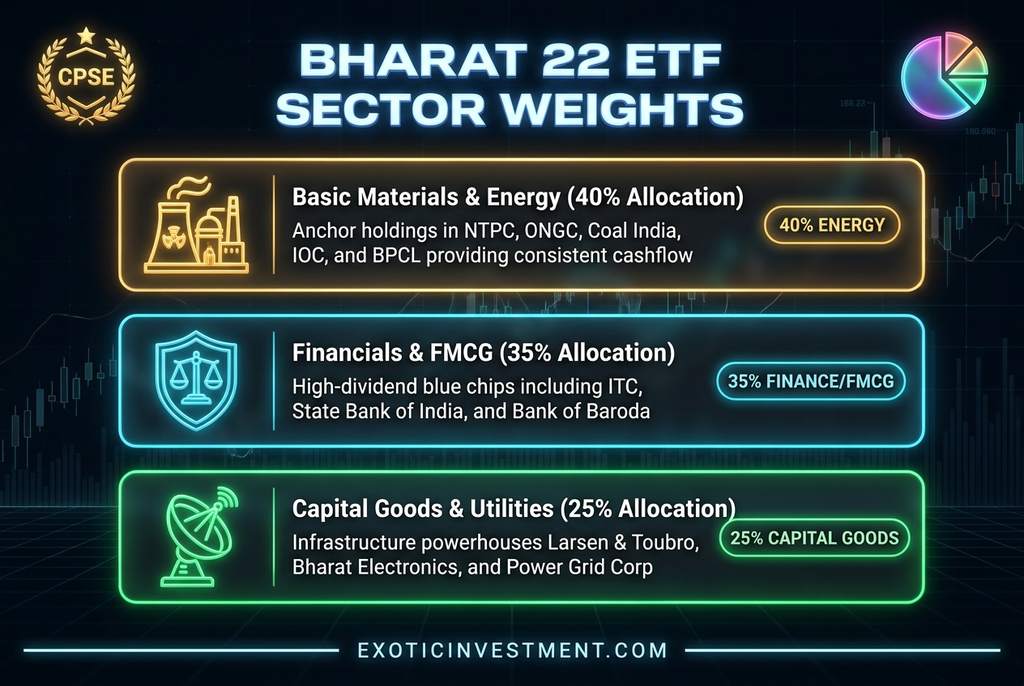
Illustration: 3 Core Sector Pillars Powering the Bharat 22 Index Allocation
Sector Allocation and Top Stock Holdings of Bharat 22 Index
The Bharat 22 portfolio is strategically diversified across six foundational economic sectors, providing balanced exposure to both public and private blue chips. Specifically, studying this constituent distribution reveals how utility defensive strength combines with cyclical industrial growth.
| Economic Sector | Target Weight | Anchor Stock Holdings |
|---|---|---|
| Basic Materials & Energy | ~40% Allocation | NTPC, ONGC, Coal India, BPCL, Indian Oil Corp |
| Financial Services & FMCG | ~35% Allocation | ITC Ltd, State Bank of India, Bank of Baroda |
| Capital Goods & Utilities | ~25% Allocation | Larsen & Toubro, Power Grid Corp, BEL |
First, the heavy presence of cash-rich energy and utility giants yields substantial dividend cashflows for long-term investors. Review top dividend-paying stocks in our guide to dividend yield stocks in india. Second, the inclusion of SUUTI holdings like ITC and L&T injects private sector efficiency into an otherwise sovereign basket.
In addition, investors increasing their monthly investment amounts annually can explore compounding acceleration principles in our guide on step up sip vs regular sip. Similarly, you can verify annualized returns easily using our guide on how to calculate cagr in stocks.
Historical Returns, Dividend Yield, and Valuation Multiples
Historically, the Bharat 22 Index has generated compelling risk-adjusted returns during periods of domestic economic expansion and capital expenditure revival. Because the portfolio holds sovereign utilities with regulated returns on equity, downside volatility is cushioned by substantial dividend yields. In fact, aggregate index dividend yields historically fluctuate between 3.0% and 4.2%, substantially exceeding typical Nifty 50 yields.
In addition, evaluating fundamental valuation ratios like Price-to-Earnings and Price-to-Book reveals that PSU constituents frequently trade at substantial discounts to private peers. You can estimate equity valuation multiples using our dedicated pe ratio calculator. In fact, assessing financial statement metrics ensures you never overpay for cyclical earnings, as explained in our guide to how to read a balance sheet.
Finally, long-term investors should evaluate their portfolio cashflow requirements before committing large lump sums to thematic funds. If you plan to generate passive income from your accumulated corpus, explore systematic withdrawal strategies in our guide on swp in mutual funds. Therefore, pairing high-dividend ETFs with systematic withdrawals provides dependable financial freedom.
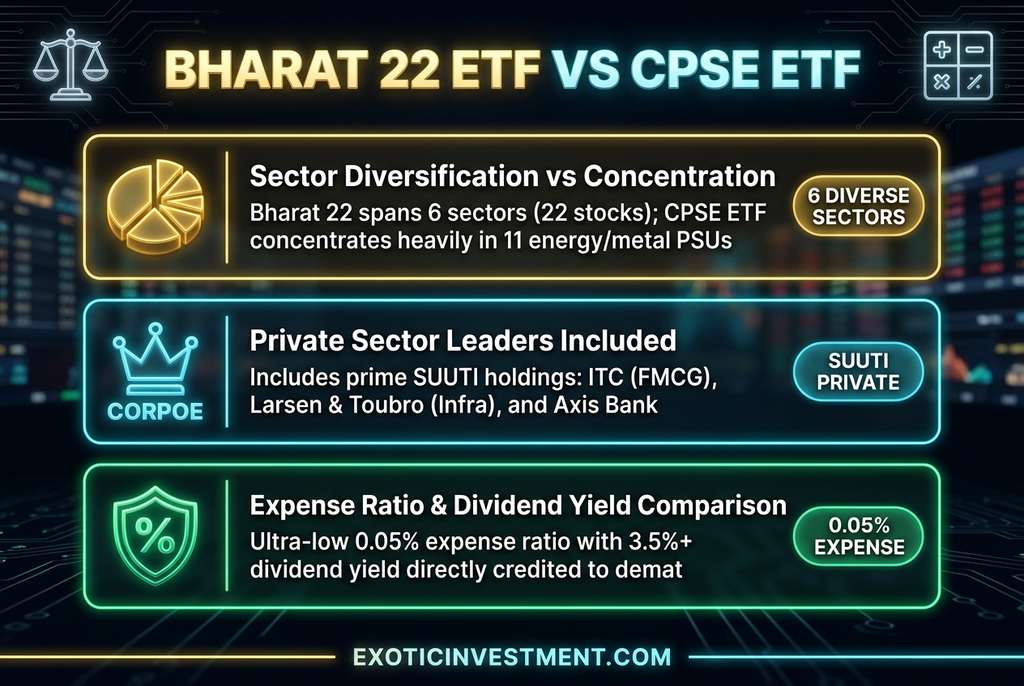
Illustration: Bharat 22 ETF vs CPSE ETF: Comparing Diversification, Private Holdings, and Expense Ratios
Bharat 22 ETF vs CPSE ETF: Key Differences Explained
Many investors confuse Bharat 22 ETF with the CPSE ETF, but their underlying portfolio structures differ significantly. While CPSE ETF holds only 11 public sector undertakings with heavy exposure to energy and metals, Bharat 22 includes 22 scrips across six diverse industries.
Most importantly, Bharat 22 ETF holds shares of leading private companies held through the Specified Undertaking of the Unit Trust of India (SUUTI). For instance, heavyweight holdings in ITC, Larsen & Toubro, and Axis Bank provide diversification that pure PSU funds lack. To compare trading and statutory fees across brokers, use our upstox brokerage calculator.
🚀 Master Stock Valuation & Long-Term Compounding
Discover how institutional analysts evaluate balance sheets, detect economic moats, and identify multibaggers. Learn directly from Dr. Ashok Kumar N Rao.
- Understand corporate cashflow and market principles with our book Kaliyiri Share Market Book and our English handbook Basics of Indian Stock Market Book.
- Accelerate your research with institutional screeners through the MultiBagger Plus Courses & Pro Tools Annual Subscription.
- Master chart setups by enrolling in our structured Technical Analysis Course in Kannada or options mechanics in our Options Buying Course in Kannada.
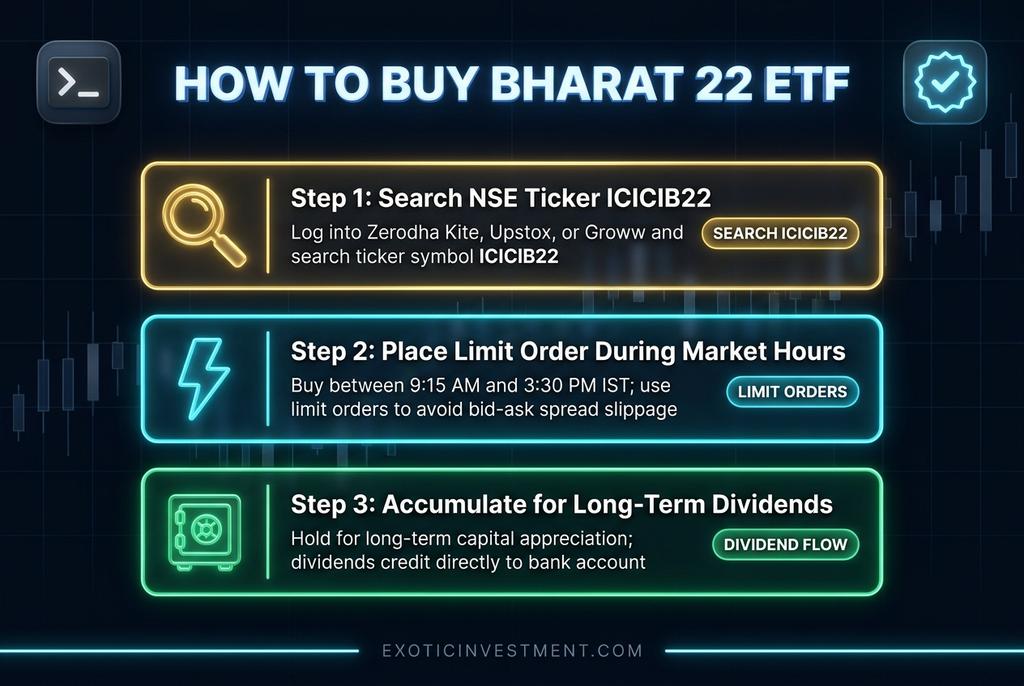
Illustration: 3 Step Execution Guide to Buy Bharat 22 ETF on Leading Indian Broker Terminals
Step-by-Step: How to Buy Bharat 22 ETF on Leading Brokers
Investing in Bharat 22 ETF is as straightforward as purchasing any equity share on NSE or BSE. Follow this operational guide:
- Search the ETF Ticker: Open Zerodha Kite, Upstox, or Groww and search for the ticker symbol ICICIB22 or BHARAT22.
- Place a Limit Order: Always execute your purchase using a Limit Order between 9:30 AM and 3:00 PM IST to avoid bid-ask spread slippage.
- Review Trading Costs: Confirm your zero delivery brokerage status and examine statutory transaction fees using our zerodha brokerage calculator.
- Plan Tax Implications: Capital gains on equity ETFs held over 12 months qualify for 12.5% LTCG above ₹1.25 Lakh, while short-term trades trigger 20% STCG. Review tax laws in our guide to stock market profit taxation in india.
In addition, traders managing active swing positions alongside long-term ETF holdings should apply structured chart triggers, as explained in our guide on how to choose stocks for swing trading. Similarly, you can compare index fund alternatives by exploring how to invest in nifty 50. Consequently, combining broad index funds with thematic ETFs creates a resilient investment portfolio.
Finally, disciplined capital allocation requires strict risk management, as outlined in our guide on risk to reward ratio and position sizing. In addition, you can estimate optimal trade sizing allocations using our position size calculator. Therefore, disciplined position limits protect your wealth through market cycles.
💡 Frequently Asked Questions
1. What is the NSE ticker symbol for Bharat 22 ETF?
The primary trading ticker symbol for Bharat 22 ETF on the National Stock Exchange is ICICIB22. You can buy and sell units directly through any depository broker during regular market hours. Learn more about trade fee breakdowns with our stock brokerage calculator.
2. Does Bharat 22 ETF pay cash dividends?
Yes, companies in the index declare substantial corporate dividends throughout the financial year. The AMC distributes these dividend earnings to registered unit holders, crediting funds directly to linked savings accounts. Review top cash cows in our guide to dividend yield stocks in india.
3. What is the expense ratio of Bharat 22 ETF?
Bharat 22 ETF has an ultra-low expense ratio of roughly 0.05%, making it one of the most cost-effective equity funds in India. In contrast, actively managed mutual funds often charge between 1.0% and 2.0% annually. Discover how lower fees accelerate wealth in our direct vs regular mutual funds guide.
4. Can I start a monthly SIP in Bharat 22 ETF?
Yes, leading brokers like Zerodha, Groww, and Upstox allow you to create recurring stock SIP baskets containing ICICIB22 units. This automates rupee-cost averaging across the 22 constituent stocks. Review systematic equity rules in our master guide on what is stock sip.
5. How are capital gains taxed on Bharat 22 ETF?
Bharat 22 ETF is taxed as an equity-oriented financial instrument under Indian tax law. Selling units within 12 months incurs a 20% Short-Term Capital Gains tax, while holdings exceeding 12 months qualify for 12.5% Long-Term Capital Gains above ₹1.25 Lakh. Learn complete tax filing provisions in our guide to stock market profit taxation in india.